
What Exploration Diving Actually Feels Like
The First Feeling Is Usually Anticipation
Then You Enter the Cave
The Cave Doesn’t Tell You What Comes Next
Exploration Is Surprisingly Quiet
A Dead End Is Still Information
I’ve Spent Years Chasing Answers
Some Exploration Is Measured in Years, Not Dives
Exploration Can Be Physically Difficult
The Mental Part Is Probably Harder
The Farther You Go, the More Important Control Becomes
There Is a Moment When Curiosity Takes Over
You Start Asking Different Questions
Sometimes You Have to Walk Away
Exploration Changes How You See Failure
The Best Part Isn’t Always the Discovery
What Exploration Actually Feels Like
The Drive Never Really Ends
Free PDF Download
Download The 10 Most Common Sidemount Configuration Mistakes and learn how to improve trim, streamline your equipment, and avoid the setup errors that frustrate many sidemount divers.
Get the Free Guide →
✓ Includes Configuration Checklist
✓ Includes Self-Assessment Worksheet
✓ Instant Download
People sometimes ask what it feels like to explore an underwater cave that nobody, or very few people, have been through before. It’s difficult to answer. I’ve written a few books about my explorations, but even those don’t capture the exact feeling. You can describe the darkness. The silence. The equipment. The distance. The physical effort. You can explain the planning, the navigation, the gas management, and the risks. But none of that completely captures what exploration diving actually feels like.
Exploration isn’t simply cave diving in a place you’ve never seen. It’s entering an environment without knowing exactly what you’re going to find, how far you can go, whether the passage will continue, or whether the answer you’ve been looking for is around the next corner. Or doesn’t exist at all.
Sometimes you can spend years looking for that answer. I’ve learned that firsthand.
The First Feeling Is Usually Anticipation
Before the dive even begins, exploration feels different. There is a question in your head. Maybe you’ve seen something on a previous dive that doesn’t make sense. Maybe a passage appears to continue beyond where you’ve explored. Maybe two cave systems seem as though they should connect. Maybe you’re following a lead that has been sitting in the back of your mind for months or years.
You don’t know the answer yet. That’s what makes it exploration. The preparation is familiar. The equipment is familiar. The cave environment may even be familiar. But the objective isn’t. You are preparing to find out something you don’t already know. That creates a different kind of anticipation than a normal dive.
Then You Enter the Cave
Once you’re underwater, the outside world disappears. There is no sound of traffic. No phone. No conversation. No distractions. There is just the equipment, the cave, your team, and the decisions that have to be made.
Exploration doesn’t feel dramatic every second. In fact, much of it feels remarkably controlled. You are maintaining trim. Monitoring gas. Managing your equipment. Following the line. Watching the passage. Making decisions.
Then you notice something. A passage you’ve never seen before. A restriction. A change in direction. A small opening that might lead somewhere. A feature that doesn’t appear on the map because there is no map yet.
That’s when the dive changes.
The Cave Doesn’t Tell You What Comes Next
When you’re diving a known cave, you generally know what you’re going to encounter. You’ve seen the passage. You know where the restrictions are. You know where the jumps are. You know what the cave looks like.
Exploration removes that certainty. The passage may become smaller. It may get larger. It may turn. It may close. It may open into something completely different. You don’t know. That uncertainty is one of the things that makes exploration so compelling. You aren’t simply traveling through a cave. You’re trying to understand it while you’re inside it.
Exploration Is Surprisingly Quiet
When people imagine exploration, they sometimes picture constant excitement. It isn’t. There can be long stretches where almost nothing happens. You move forward. You examine the passage. You check your equipment. You maintain awareness of the team. You look for the next possibility. Then you stop.
Maybe the passage doesn’t continue. Maybe there’s another lead. Maybe something you thought was promising turns out to be nothing. That’s part of it.
Exploration isn’t a continuous series of discoveries. Most of the time, you’re collecting information.
A Dead End Is Still Information
One of the biggest lessons exploration has taught me is that a dive doesn’t have to produce a major discovery to be useful. A passage that closes tells you something. A restriction that cannot reasonably be passed tells you something. A route that doesn’t go where you expected tells you something. Even a dive where you accomplish less than you hoped can change what you do on the next dive.
That’s important because exploration can otherwise become frustrating. If the only definition of success is finding new passage, you’re going to have a lot of unsuccessful dives. The real process is cumulative. One dive gives you a piece of information. Another dive gives you another piece of information. Eventually those pieces begin to fit together.
I’ve Spent Years Chasing Answers
I’ve experienced this firsthand in Cozumel. It took me almost two years to find the connection between Cueva Quebrada and Dos Coronas. Two cave systems that had been separate in my experience eventually became connected through exploration. But the connection didn’t appear simply because I wanted it to. There were dives where the answer wasn’t there. There were leads to investigate. There were possibilities that didn’t work. And there was the need to keep returning and looking at the problem differently.
When the connection finally came together, the discovery was significant. But what I remember even more is everything that came before it. That’s exploration. The discovery is only one moment. The process leading to it can take years.
Exploration Beyond the Dive
Much of what I’ve learned through exploration doesn’t end when the dive is over. The dives become maps, photographs, notes, questions, and eventually stories. I’ve documented some of those experiences in my Underwater Exploration Series, including The Hidden Rivers of Florida: Discoveries, Beneath the Jungle of Cozumel: Connecting the Crowns, and Beneath the Jungle of Cozumel: Hidden Passages.
These books aren’t simply about where the caves are. They’re about the exploration itself. The discoveries, the challenges, the places that didn’t make sense at first, and the process of trying to understand what lies beyond the next passage.
If you’re interested in the exploration side of cave diving, you can explore the Underwater Exploration Series and follow some of those journeys beyond the dive.
Some Exploration Is Measured in Years, Not Dives
The same thing happened during my exploration of the Escondido section. It took years to complete. That changes your relationship with exploration. You stop expecting every dive to produce something dramatic. You begin to understand that some projects simply take time.
I’ve also been working on Florida exploration projects for several years. The drive doesn’t disappear because a particular project takes longer than expected. If anything, the unanswered questions become part of what keeps you going. There is always another passage. Another lead. Another possibility. Another question.
Exploration Can Be Physically Difficult
There is also a physical side that photographs don’t show. Moving equipment through difficult cave environments takes work. Restrictions require control. Long dives require discipline. Scootering, swimming, carrying stages, managing equipment, and maintaining awareness all require energy. And the further you penetrate, the more important that energy management becomes.
You’re not simply thinking about getting somewhere. You’re thinking about having enough capacity – physically, mentally, and with your equipment – to return.
Exploration rewards efficiency. The less unnecessary work you do, the more attention you have available for the things that matter.
The Mental Part Is Probably Harder
The physical challenge is obvious. The mental challenge is less visible. You have to remain patient when the cave doesn’t give you an answer. You have to remain disciplined when you think you’ve found something exciting. You have to recognize when a lead isn’t worth pursuing. And sometimes you have to turn around. That can be difficult when you have spent months thinking about a particular possibility.
The cave doesn’t care how much time you’ve invested. It doesn’t care how far you’ve traveled to get there. It doesn’t care how badly you want the answer. If the conditions aren’t right, you turn around. If the passage doesn’t make sense, you don’t force it. If the team isn’t comfortable continuing, you reassess.
Exploration requires curiosity. But curiosity without judgment is a liability.
The Farther You Go, the More Important Control Becomes
Exploration isn’t about being fearless. I’ve never considered fearlessness to be the objective. You need awareness. You need to recognize what is happening around you and respond appropriately. The farther you penetrate, the less room there is for unnecessary mistakes.
Equipment has to work. Gas management has to be disciplined. Navigation has to remain understandable. The team has to know what is happening. And you have to remain capable of making good decisions even when the dive isn’t going exactly as planned.
That’s why exploration is as much about restraint as it is about pushing forward.
There Is a Moment When Curiosity Takes Over
Despite all of that discipline, there is still something difficult to describe about seeing a passage for the first time. You approach something that has never been part of your experience. The light moves across the walls. The passage continues beyond what you can immediately see. You don’t know where it goes. For a moment, you’re looking at something that exists, but isn’t yet part of anyone’s map or understanding.
That’s an incredible feeling. Not because you’ve conquered something. Because you’ve discovered something. There’s a difference.
You Start Asking Different Questions
Early in an exploration project, the question may be:
Where does this go?
Then it becomes:
Does this connect to something else?
Then:
Why does the cave behave this way?
Then:
What is beyond that restriction?
Every answer creates another question. That’s one of the reasons the drive to explore doesn’t end with a discovery. The discovery doesn’t close the story. It opens another chapter.
Finding the connection between Cueva Quebrada and Dos Coronas didn’t eliminate the questions. It created new ones.
Completing one section of cave doesn’t mean there isn’t another section waiting to be understood.
That’s the nature of exploration.
Sometimes You Have to Walk Away
One of the hardest lessons is knowing when to stop looking. Not every lead needs to be solved today. Sometimes the conditions aren’t right. Sometimes the passage requires a different approach. Sometimes you don’t have the right configuration. Sometimes you’ve simply reached the point where continuing isn’t productive.
Walking away can feel like giving up. It isn’t. I’ve learned that sometimes the best thing you can do is leave the question unanswered and come back later. The cave will still be there. And you may see something differently the next time.
Exploration Changes How You See Failure
A dive that doesn’t produce new passage can feel like a failure if you’re measuring it only by distance. I don’t look at it that way anymore. Maybe you eliminated a possibility. Maybe you learned something about the cave. Maybe you found a better route. Maybe you identified a problem with your approach. Maybe you discovered that your original assumption was wrong.
That’s progress.
Exploration isn’t a straight line from question to answer. It’s usually a collection of wrong turns, partial answers, new questions, and occasional breakthroughs.
The Best Part Isn’t Always the Discovery
The obvious answer is that the best part of exploration is finding something new. And it is. But there is another part I enjoy just as much. The process of figuring something out.
Looking at a passage. Thinking about what it might mean. Returning to it. Trying another approach. Comparing what you saw on one dive with what you saw on another. Slowly building an understanding of something that didn’t make sense before.
The discovery is the moment everyone remembers. The process is what makes the discovery possible. And, to be honest, the process is my favorite part.
When I found the connection between Dos Coronas and Cueva Quebrada, initially there was excitement. Then came the disappointment. The chase was over. The objective had been achieved.
The question that popped into my head at that point was “What now?” I had devoted two years of my life to searching for that connection. Once I found it, I had an empty feeling left inside me.
What Exploration Actually Feels Like
So what does exploration diving actually feel like? It feels like curiosity mixed with discipline. It feels like excitement tempered by caution. It feels like spending hours underwater for a few minutes of something completely new. It feels like returning from a dive without the answer you wanted and realizing you still learned something. It feels like knowing that the cave has no obligation to give you what you’re looking for. It feels like being patient. It feels like being frustrated. It feels like being completely focused.
And occasionally, it feels like seeing something for the first time that you know nobody has seen from that perspective before and that no one may ever see after you.
Those moments are difficult to describe. You don’t own the cave. You haven’t conquered it. You’ve simply been given the opportunity to see a little more of it.
The Drive Never Really Ends
I spent almost two years looking for one connection. Years exploring another section. And several years working on Florida exploration projects. The common thread through all of them is that the drive never really ends.
There is always another question. Another lead. Another passage. Another possibility.
Exploration has taught me that patience isn’t simply waiting for something to happen.
It’s continuing to work when you don’t know when the answer will come.
And maybe that’s what exploration diving actually feels like.
Not knowing, but looking anyway. And being willing to come back tomorrow and look again.
The drive to explore doesn’t end when you make a discovery. It starts with the next question.
Want to go deeper into the exploration?
Follow the discoveries beyond the dive in Rob Neto’s Underwater Exploration Series.
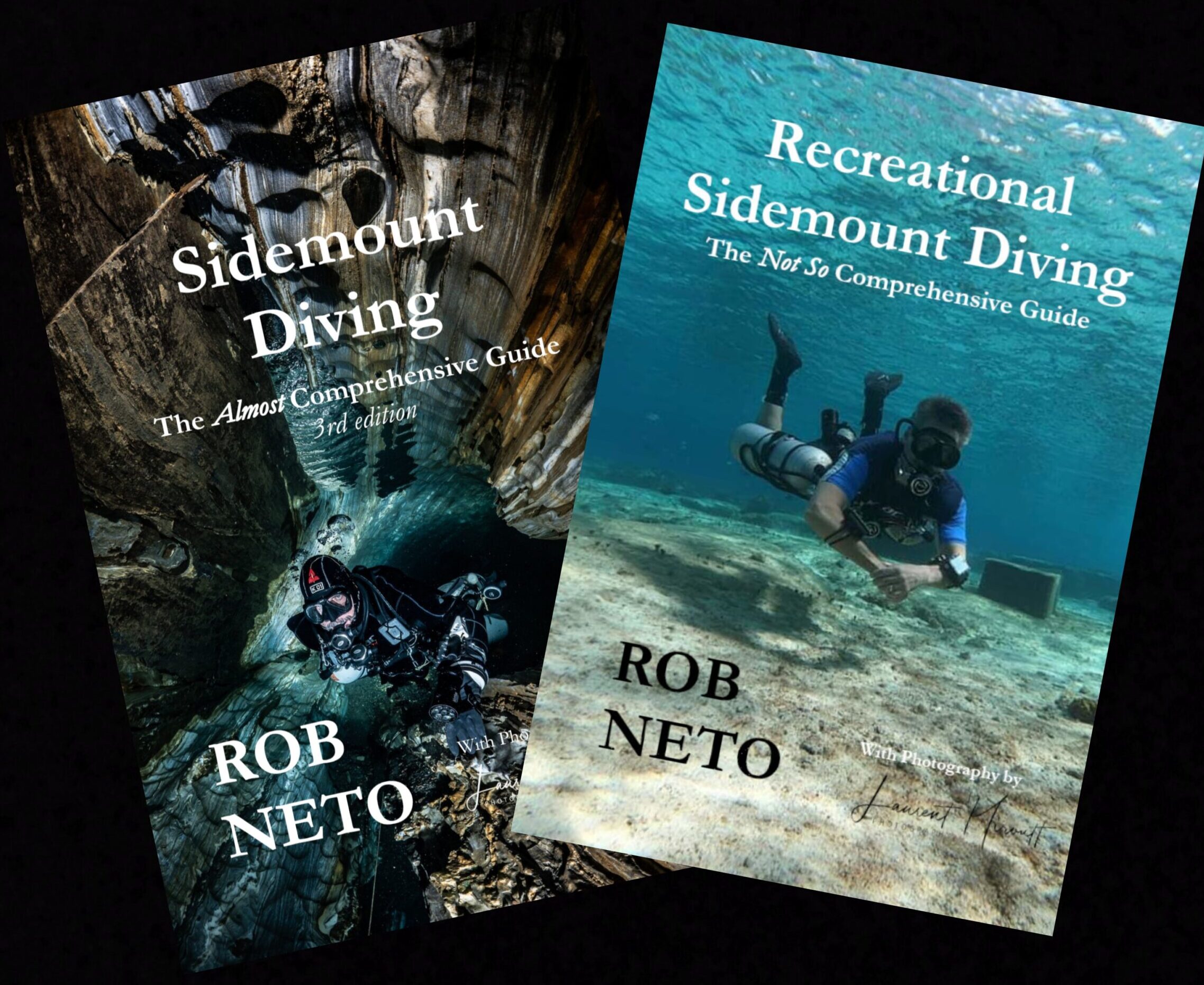
If you found this article helpful, you can receive $10 off the book Sidemount Diving when purchasing directly from the website.
Use code EXPLORATION10 during checkout.
Free PDF Download
Enjoyed this article?
Download The 10 Most Common Sidemount Configuration Mistakes and get the configuration checklist and self-assessment worksheet.
Get the Free Guide →
✓ Includes Configuration Checklist
✓ Includes Self-Assessment Worksheet
✓ Instant Download