
The Psychology of Tight Spaces in Cave Diving
“Why Would Anyone Do That?”
Cave Divers Aren’t Born Without Fear
Familiarity Changes Perspective
Training Builds Confidence, Not Invincibility
Comfort Zones Grow Slowly
Claustrophobia Isn’t the Same for Everyone
Good Judgment Means Saying “No”
Exploration Changes the Equation
The Real Challenge Isn’t the Restriction
Why People Find It Fascinating
Final Thoughts
Free PDF Download
Download The 10 Most Common Sidemount Configuration Mistakes and learn how to improve trim, streamline your equipment, and avoid the setup errors that frustrate many sidemount divers.
Get the Free Guide →
✓ Includes Configuration Checklist
✓ Includes Self-Assessment Worksheet
✓ Instant Download
“Why Would Anyone Do That?”
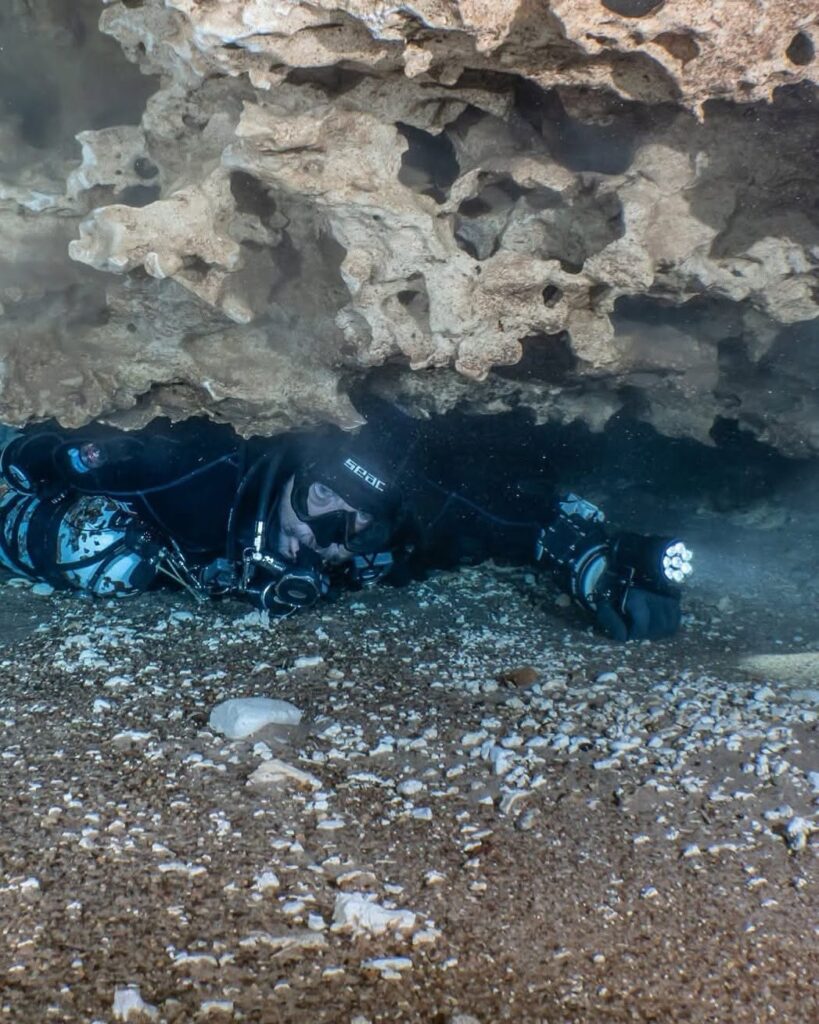
Whenever I post a photograph of myself passing through a tight restriction, the comments are remarkably consistent.
- “Nope.”
- “Absolutely not.”
- “You couldn’t pay me enough.”
- “I started feeling anxious just looking at the picture.”
For most people, those reactions are completely understandable.
Humans are naturally uncomfortable in confined spaces. Our brains are wired to recognize situations that appear threatening, especially when movement seems restricted and escape looks difficult.
So why would anyone voluntarily swim through a space that most people wouldn’t even crawl into?
The answer has less to do with fearlessness than many people imagine.
Cave Divers Aren’t Born Without Fear
One of the biggest misconceptions about cave divers is that we simply don’t get scared. Nothing could be further from the truth. Good cave divers respect fear.
Fear exists for a reason. It keeps us alert, encourages preparation, and reminds us that the environment deserves respect. The goal isn’t to eliminate fear. The goal is to prevent fear from becoming panic. Those are two very different things.
Familiarity Changes Perspective
When someone unfamiliar with cave diving sees a tight restriction, they often focus on one thing:
“What if I get stuck?”
Experienced cave divers see something different.
They evaluate:
- How wide is the restriction?
- What is the rock made of?
- Is there room to turn?
- Can equipment remain on?
- Is there another route?
- What are the consequences if visibility drops?
- What does the exit look like?
Experience replaces imagination with observation. That doesn’t remove the risk. It simply allows the diver to evaluate it more objectively.
Training Builds Confidence—Not Invincibility
Every skill learned during cave training serves a purpose.
- Buoyancy.
- Trim.
- Propulsion.
- Equipment management.
- Gas planning.
- Emergency procedures.
None of these eliminate risk. They reduce uncertainty.
Confidence comes from preparation, repetition, and experience, not from believing nothing can go wrong.
The diver in this photograph didn’t become comfortable in tight spaces overnight. That confidence was earned over hundreds of dives, countless hours of training, and a commitment to turning around whenever the conditions demanded it.
Comfort Zones Grow Slowly
Nobody begins cave diving by swimming through restrictions. The progression happens gradually.
- Open water.
- Cavern.
- Introductory cave training.
- Simple passages.
- Full cave training.
- Increasing complexity.
- Specialty training.
- Years of experience.
Each dive builds upon the previous one. What once seemed intimidating eventually becomes familiar.
The restriction hasn’t changed. The diver has.
Claustrophobia Isn’t the Same for Everyone
People often assume every cave diver is immune to claustrophobia. That’s rarely true. Many cave divers are uncomfortable in elevators, crawl spaces, or crowded rooms. Yet they feel completely at ease underwater.
Why? Because the environment is predictable.
- The divers understand their equipment.
- They know their procedures.
- They trust their training.
The feeling isn’t one of being trapped. It’s one of being prepared.
Good Judgment Means Saying “No”
Perhaps the biggest misconception is that experienced cave divers always go through every restriction they encounter.
They don’t.
Sometimes the smartest decision is to turn around.
Restrictions may be rejected because of:
- poor visibility
- equipment issues
- fatigue
- unfamiliar conditions
- limited experience
- changing objectives
Turning a dive is never failure. It’s judgment.
The best cave divers aren’t the ones who squeeze through the smallest openings. They’re the ones who consistently make good decisions.
Looking at the photograph at the top of this article, many people assume I enjoy squeezing through tight spaces. That’s not really what I enjoy. What I enjoy is solving the puzzle of exploration, moving efficiently through the cave, and reaching places few people have ever seen. The restriction is simply one obstacle along the way. If the risk outweighs the reward, I’ll turn the dive. There will always be another opportunity.
Exploration Changes the Equation
For exploration divers, restrictions often represent possibility. A tight passage may lead to hundreds or even thousands of feet of unexplored cave beyond. That potential doesn’t erase the risk. But it helps explain why explorers are willing to invest the time, planning, and effort required to evaluate whether continuing makes sense.
Exploration isn’t about proving courage. It’s about answering questions that no one has answered before.
The Real Challenge Isn’t the Restriction
Ironically, the physical restriction is often the easiest part. The greater challenge is maintaining discipline.
- Slow breathing.
- Controlled movement.
- Situational awareness.
- Respect for the environment.
- Patience.
These qualities matter far more than the size of the opening.
Divers who remain calm will almost always perform better than those who try to force their way through.
Why People Find It Fascinating
Even those who say they’d never do it often continue watching. There’s something deeply compelling about seeing another person venture into a place our instincts tell us to avoid. Maybe it’s curiosity. Maybe it’s admiration. Maybe it’s simply trying to understand a perspective so different from our own.
Whatever the reason, cave diving reminds us that human comfort zones aren’t fixed. They’re shaped by preparation, experience, and the choices we make.
Final Thoughts
Whenever someone comments, “I could never do that,” my response is simple. You probably couldn’t. Not today. Neither could I when I first learned to dive. Everything I’ve accomplished in cave diving has been built one dive, one skill, and one lesson at a time.
The photograph of someone swimming through a tight restriction captures only a single moment. It doesn’t show the years of training, experience, discipline, and judgment that made that moment possible.
The psychology of tight spaces isn’t about becoming fearless. It’s about learning to replace uncertainty with preparation, and knowing that the most important decision you can make is recognizing when it’s time to turn around.
If you found this article helpful, you can receive $10 off the book Sidemount Diving when purchasing directly from the website.
Use code PSYCHOLOGY10 during checkout.
Free PDF Download
Enjoyed this article?
Download The 10 Most Common Sidemount Configuration Mistakes and get the configuration checklist and self-assessment worksheet.
Get the Free Guide →
✓ Includes Configuration Checklist
✓ Includes Self-Assessment Worksheet
✓ Instant Download