
How to Choose a Sidemount Instructor
Sidemount seems a good first topic to start off with since it’s our primary choice in gear configuration. We began playing around with sidemount a few months before moving to North Florida in 2007 and immediately saw and felt the benefits of diving sidemount over diving backmount. Shortly after moving we took a couple of Dive Rite Nomads for test dives and came back with big grins on our faces and left with less money in our wallets!
At the time the Nomad and the Armadillo were the only two manufactured sidemount systems available. We had researched both and decided to go with the Nomad for a couple of different reasons. The first was the lift. The Nomad (at that time) had a lift capacity of 50 pounds while the Armadillo’s lift capacity was and is only in the mid 30 pound range. Diving the North Florida caves with steel cylinders, more lift seemed like the best decision. Another issue was the lack of availability of the Armadillo. There weren’t as many dealers carrying the Armadillo, and at some point (I can’t remember whether it was then or sometime later), no one was making or selling the Armadillo. Today it isn’t as readily available as many of the other models.
Three years later, sidemount systems flooded the market. Today, we now have several different sidemount rigs available to divers. They all have advantages and disadvantages. Some are well suited to cave diving. Some are not. In my opinion, none of them is perfect out of the box. But that’s just the nature of sidemount. The current systems widely available to divers are Dive Rite, Hollis, OMS, Oxycheq, Razor, X Deep, and many more. The Armadillo can still be found in some locations.
As I stated previously, none of these systems is perfect out of the box. I made several modifications to my Nomad and Armadillo. I’ve also made my own Frankenrig that I dive primarily in Cozumel. While the modifications I’ve made on my rig work for me, they may not work for everyone. There’s a saying, “Get 10 sidemount divers together at a dive site and you’ll see 11 different ways to rig up your gear.” You need to choose what works for you and your type of diving.
One of the things I taught in my sidemount courses was all of the possible ways to rig gear and why. I tried several of them myself. For example, I’ve pointed my SPGs in every direction possible. There are advantages and disadvantages to each of them. One of the key factors in which way you point your SPGs is your valve orientation. I’ve tried a few different valve orientations, too. After more than 20 years, I finally have things set up in a way that work for me…for now. In six months it may be different. This is what makes choosing a sidemount instructor that has experience in sidemount so important.
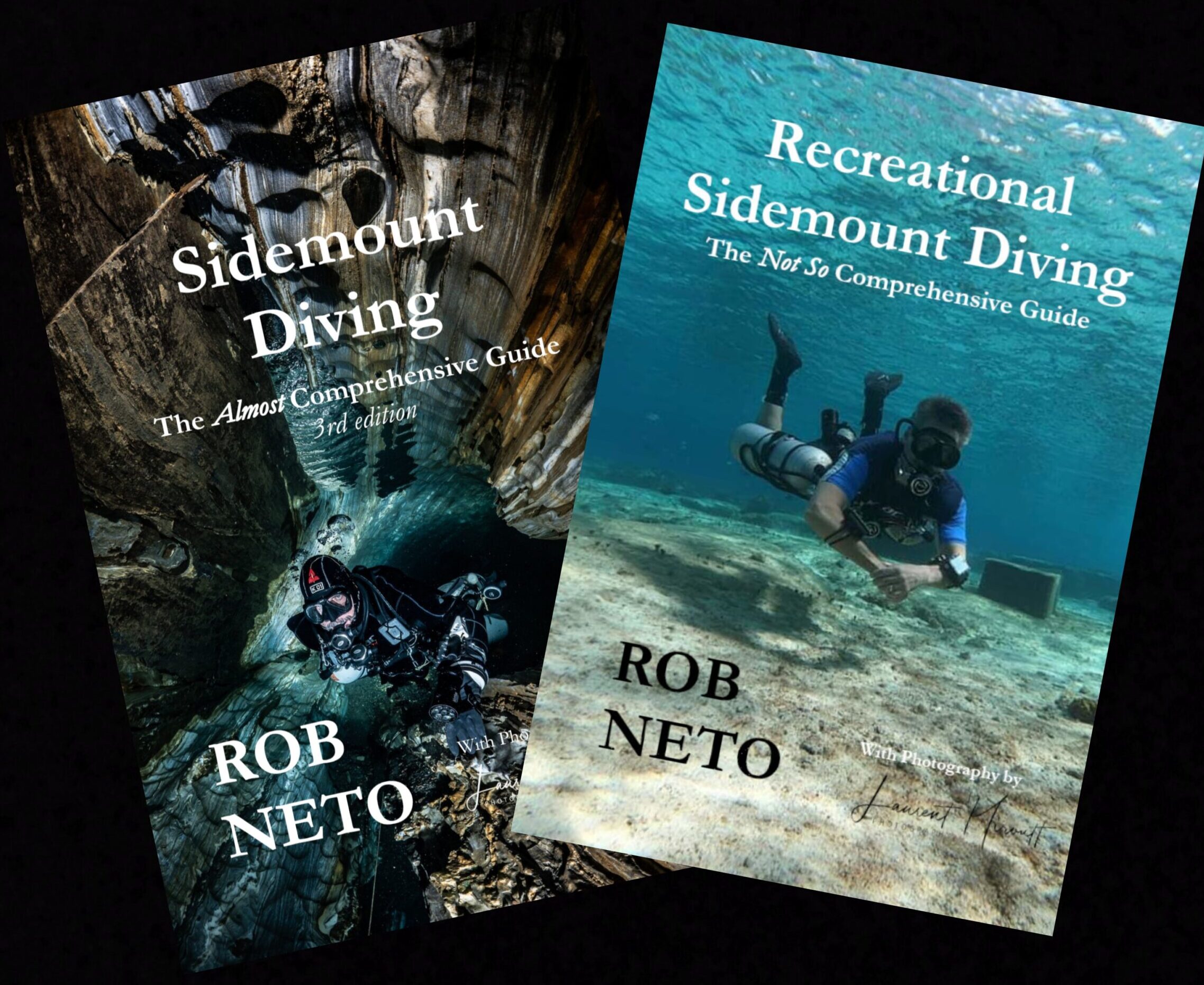
Over the years, there has been a surge in the number of sidemount instructors. Many of these instructors became sidemount divers and sidemount instructors the same weekend. They have very little experience diving sidemount and may not even dive sidemount outside of classes. Even fewer dive sidemount in caves, the original environment sidemount was conceived for. Sidemount diving is more than just strapping cylinders to your sides and getting in the water to complete drills. A big part of the course should be setting up the gear before ever getting in the water and then tweaking it between dives to work for you. An instructor who has very little experience diving sidemount isn’t going to be able to help you do this. If that’s all you want the course for, just buy a book and read it. You’ll probably get more out of that. However, if you want to learn how to set up your gear so it works for you and you want to save yourself several dozen dives in trials, find an instructor who has experience and dives sidemount to it’s fullest capabilities. Don’t only ask the instructor, but talk to other divers about the instructor. Unfortunately, there are too many instructors out there that will misrepresent their experience just to get students.
Related Articles
Sidemount vs Backmount for Cave Diving
For a complete overview of how these elements work together, see The Complete Guide to Sidemount Diving Configuration.